Reading time: 5 minutes
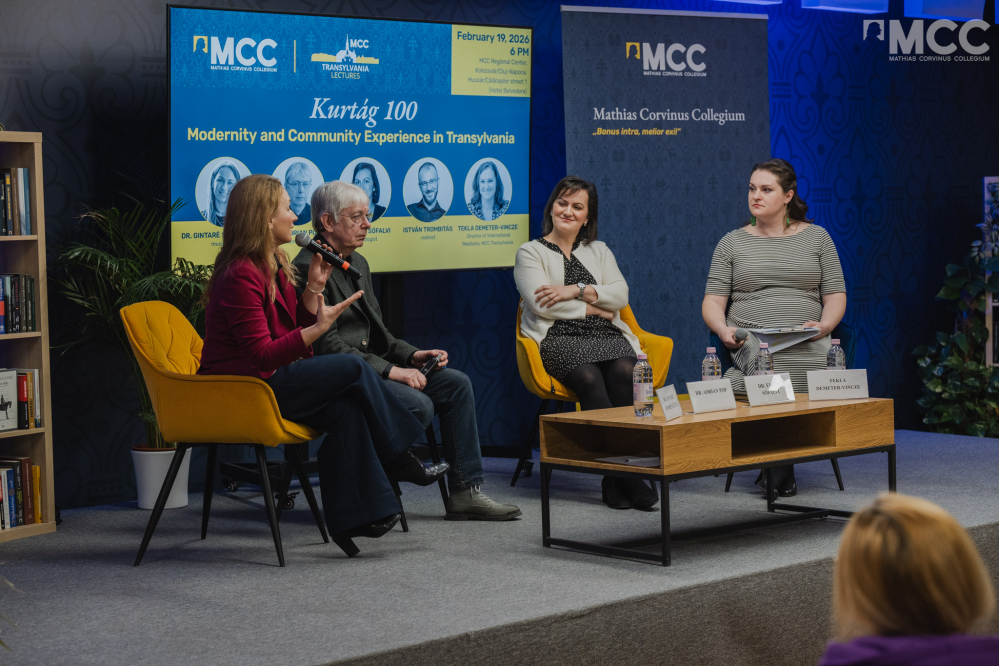
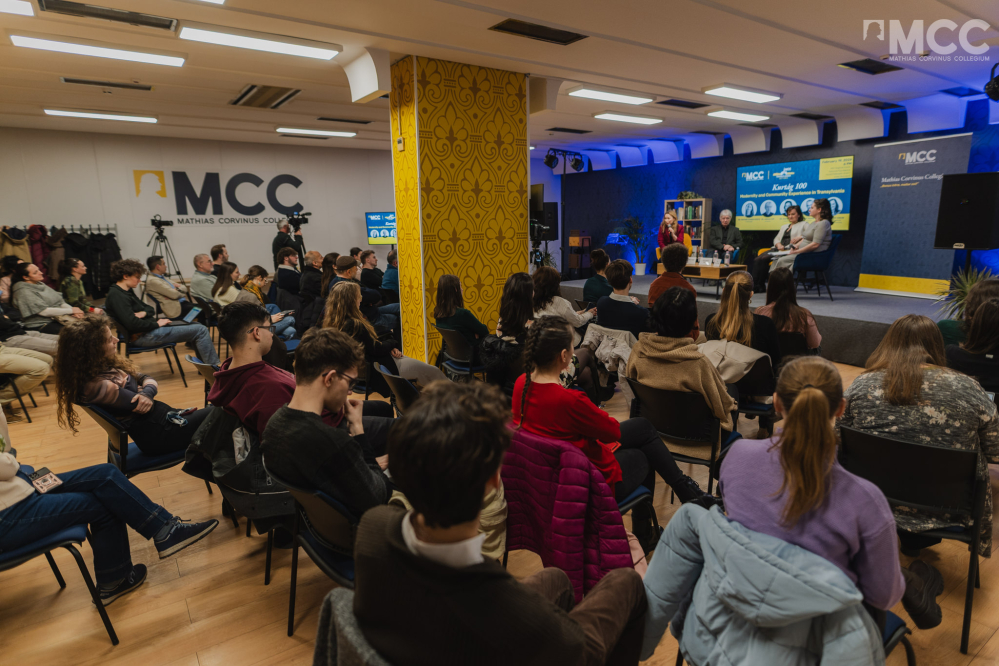
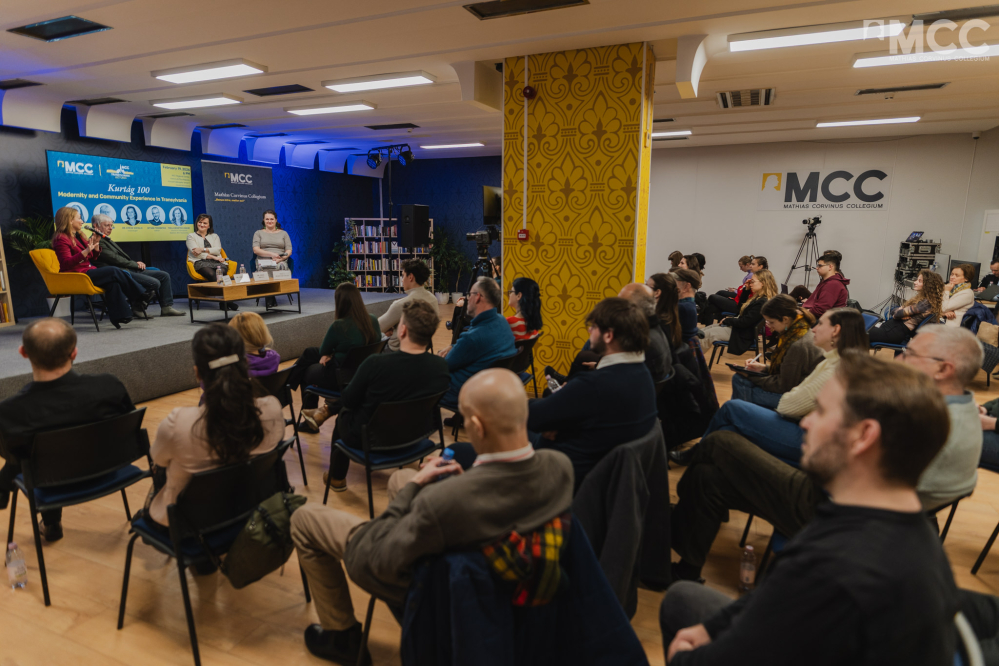
On February 19, the MCC Center in Kolozsvár/Cluj-Napoca hosted a special edition of the Transylvania Lectures series, marking the 100th birthday of György Kurtág – one of the most distinctive and influential voices of modern music. Born in Lugoj, in the Banat region, Kurtág’s life and work span a century marked by war, displacement, artistic reinvention, and radical musical compression.
The evening brought together musicologists and composers to reflect on Kurtág’s international significance, his Transylvanian roots, and a broader question: can modern music become a genuine community experience?
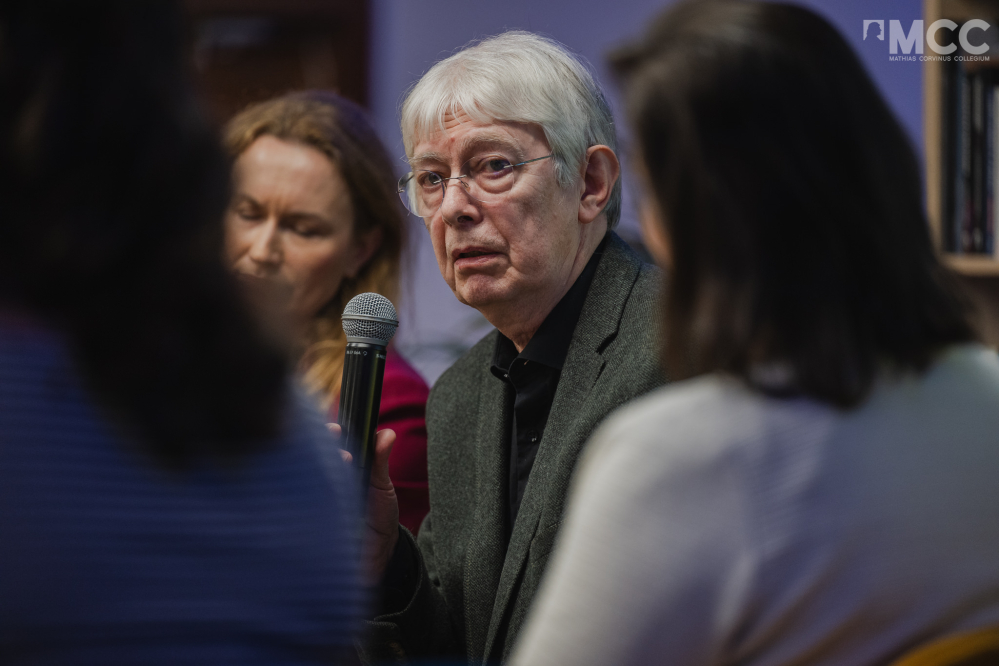
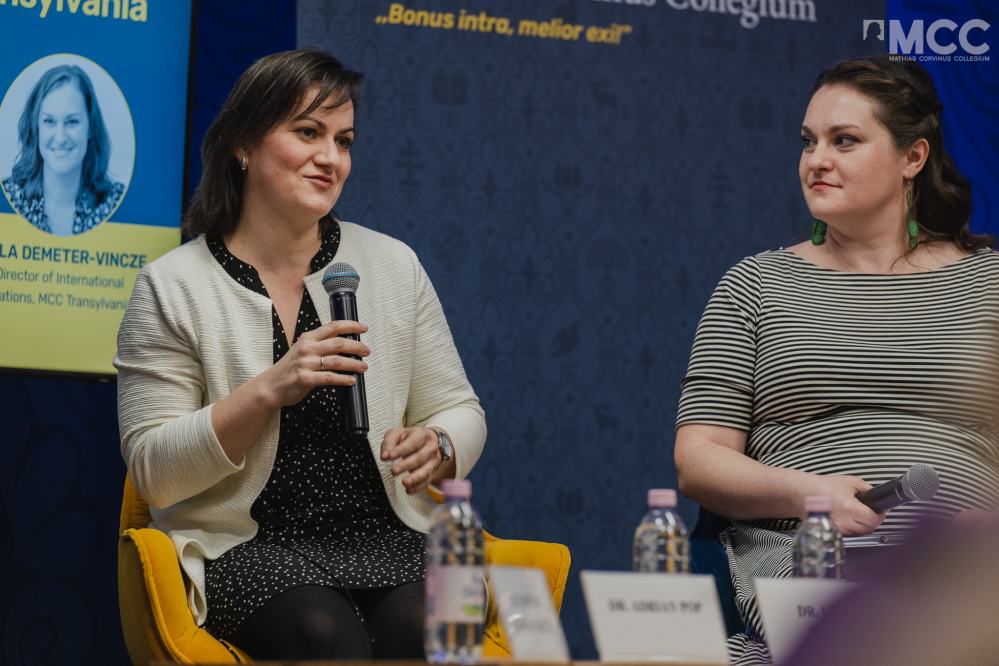
The participans were: Dr. Gintarė Stankevičiūtė, musicologist and researcher affiliated with the University of Southampton and the Lithuanian Academy of Music and Theatre; Dr. Adrian Pop, composer and professor at the Gheorghe Dima Music Academy; Dr. Emese Sófalvi, musicologist, Head of the Archive of Transylvanian Composers, and Assistant Professor at the Faculty of Reformed Theology and Music of Babeș–Bolyai University. The discussion was moderated by Tekla Demeter-Vincze, pianist and Director of International Relations at MCC in Transylvania.
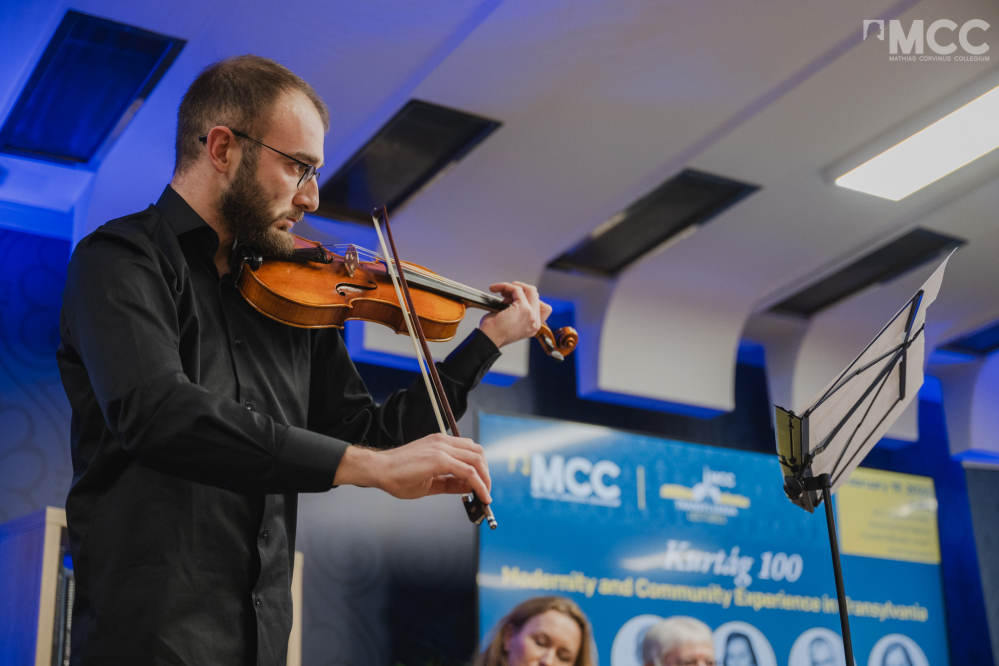
The event opened with a live violin performance by István Trombitás, setting the tone not through theory, but through sound – fragments, tension, and silence filling the room.
A Composer Who Compressed the World
Why is Kurtág considered one of the most important composers of our time? Dr. Gintarė Stankevičiūtė placed him in historical context. After Wagner’s monumental operas and Mahler’s symphonic universes, Kurtág took a radically different path: “And here comes Kurtág who thinks that the world sometimes might fit into 40 seconds.”
Kurtág did not expand musical form, he compressed it. This compression is not minimalism for its own sake, but an ethical and aesthetic stance. His music retrains the ear: “I think he retrained the way we listen to music. We started to notice silence, space between us. He started to treat silence as an important part of the structure.” Silence, in Kurtág’s work, is not absence – it is architecture.
Dr. Adrian Pop, who met Kurtág personally in 2009, emphasized how this miniature form holds immense density: “The pieces are not long, but you find the universe in each of them.”
Beyond the Composer
Kurtág was born in 1926. His lifetime includes World War II, totalitarian regimes, and the 1956 Hungarian Revolution. Fragmentation, therefore, is not unknown to him. As Dr. Gintarė Stankevičiūtė observed: these major life events influenced Kurtág’s music. He was interested in literatue and short poetic forms, and sometimes he wrote vocal pieces, using only a few words. “We shouldn’t think of him as ‚something is missing’, but in a way that no extra is allowed.”
Beyond the composer stands the person – described repeatedly as humble, precise, and deeply human. Despite global recognition, Kurtág never cultivated the myth of the romantic genius. “He worked very hard endlessly at his desk, and sometimes takook a decade to finish a piece. He's a craftsman.”
Even at over eighty years old, Kurtág retained extraordinary memory and curiosity, recalling Romanian literary details from his youth with precision. His Transylvanian childhood never faded from his artistic consciousness.
“In all the small fragments, you can find someting to relate to. He is a very charismatic person that you can connect with”, said Dr. Emese Sófalvi, adding that Kurtág’s long life is a very good mirror of our life here in Eastern Europe.
Is There Such a Thing as Transylvanian Modernity?
The panel addressed a complex question: does “Transylvanian modernity” truly exist? Dr. Adrian Pop was cautious: “Frankly, I don't know. Nowadays there is complete stylisctic democracy. It is hard to say what is the main direction in contemporary music. Authentic talent will emerge anyway. But only on the condition that they are true to their talent and would work very, very hard.”
Dr. Gintarė Stankevičiūtė noted that Transylvanian modernism is more like an attitude, it takes time to settle. “It presents memory and past in the present.”
And perhaps identity depends not only on birthplace, but on collective perception: even if artists leave, they may still belong, if the community claims them. “It's very important how the local public perceives them.”, added Dr. Emese Sófalvi.
When Does High Culture Become Community?
One of the central themes of the evening was accessibility. How does contemporary music move from “high culture” to shared experience? Dr. Gintarė Stankevičiūtė gave a determined answer: “High culture becomes a community event when we stop treating it as high culture and start treating it as necessary.”
Contemporary music, when presented as rare and exotic, remains distant. When integrated regularly into public life, it becomes part of shared cultural breathing.
The relationship between performer and audience is also crucial. In Kurtág’s music, exposure is total and this vulnerability draws listeners in: “In Kurtág’s case, a performer is very exposed. Every note is important, there is no way to hide, and the audience can feel when the performer is at risk, you dont even cough.”, added Dr. Stankevičiūtė.
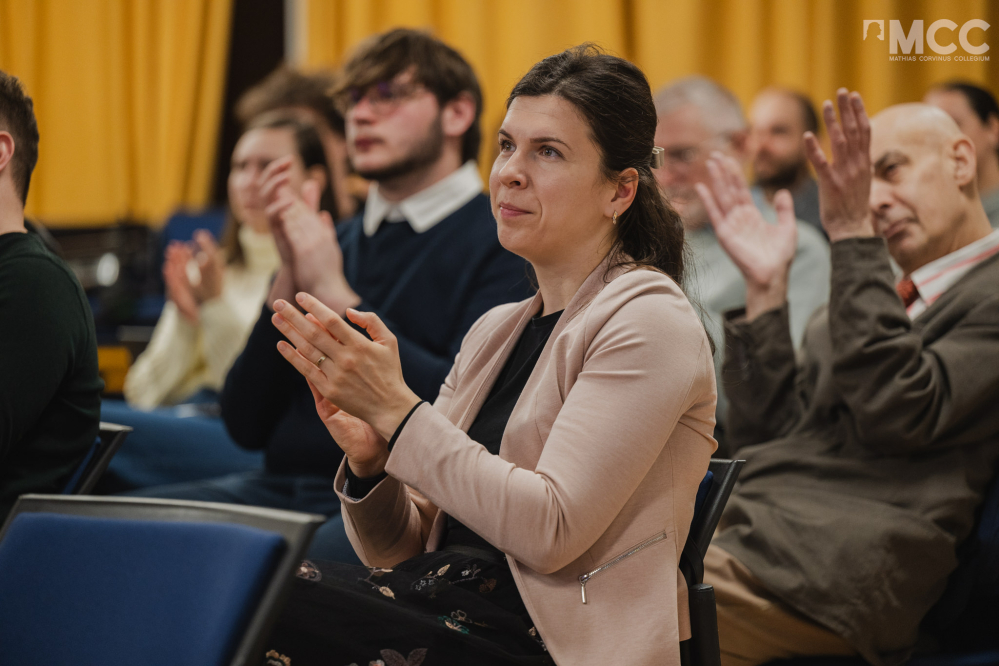
And what makes a contemporary piece truly work? The audience. Not blocking the experience with prejudices, listening with an open mind. As the participants said, it takes time to develop taste for modern music, but the beginning is always the hardest. Repetition builds familiarity and affection. Because contemporary music is not an abstract system, it is a living network of people.
At 100 years old, Kurtág remains intellectually and artistically present in the contemporary musical scene. His music demands attention, and gives it back. Fragments, when listened to together, become connection. And perhaps that is what Transylvanian modernity might mean: not a style, but a shared act of listening.