Reading time: 5 minutes
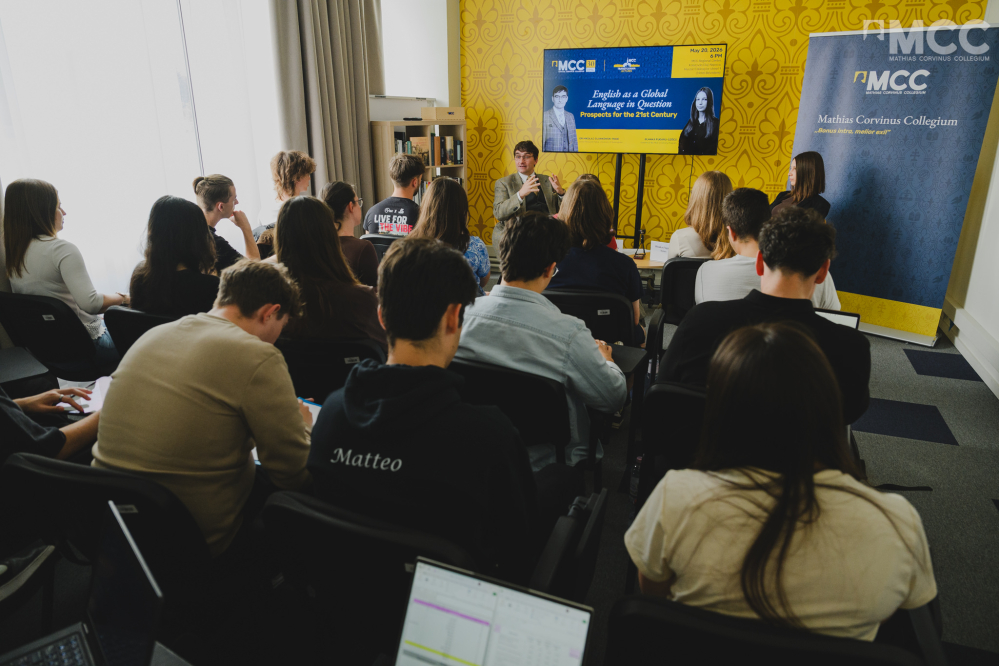
The global dominance of English may seem almost unquestionable today, yet technological progress and geopolitical shifts could gradually reshape this reality. At the MCC Transylvania Lectures event held on May 20, 2026, Dr Mikołaj Sławkowski-Rode explored the historical and cultural factors that made English a global language and reflected on how sustainable this role may be in the long run.
For decades, English has been regarded as the world’s dominant language. However, this may not always remain the case. The growing influence of Spanish and Mandarin Chinese, the revival of regional linguistic identities, and the rapid development of instant translation technologies may all contribute to a transformation of the global linguistic landscape.
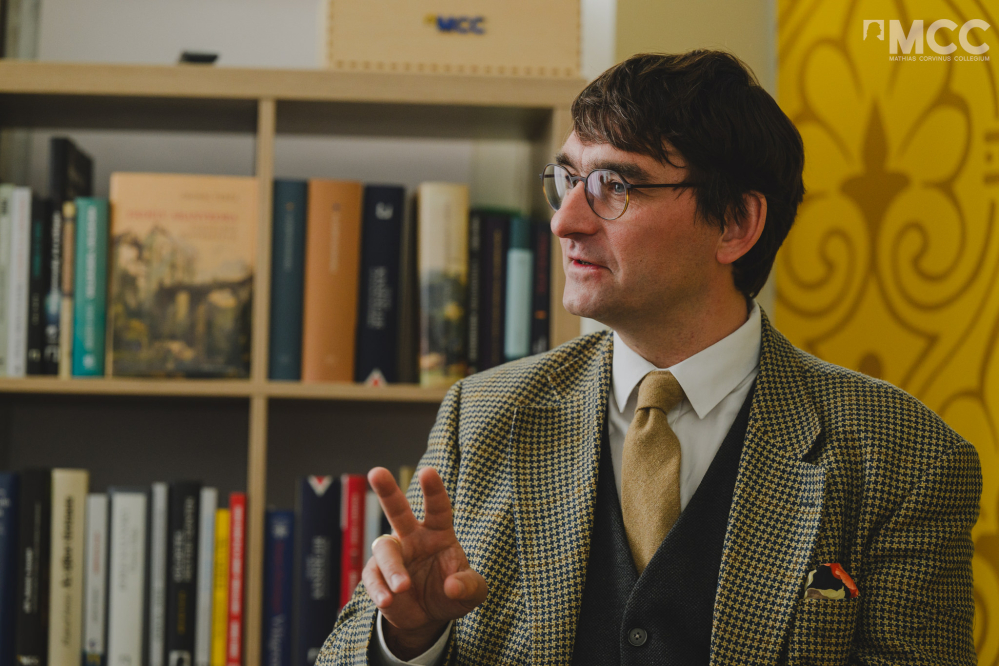
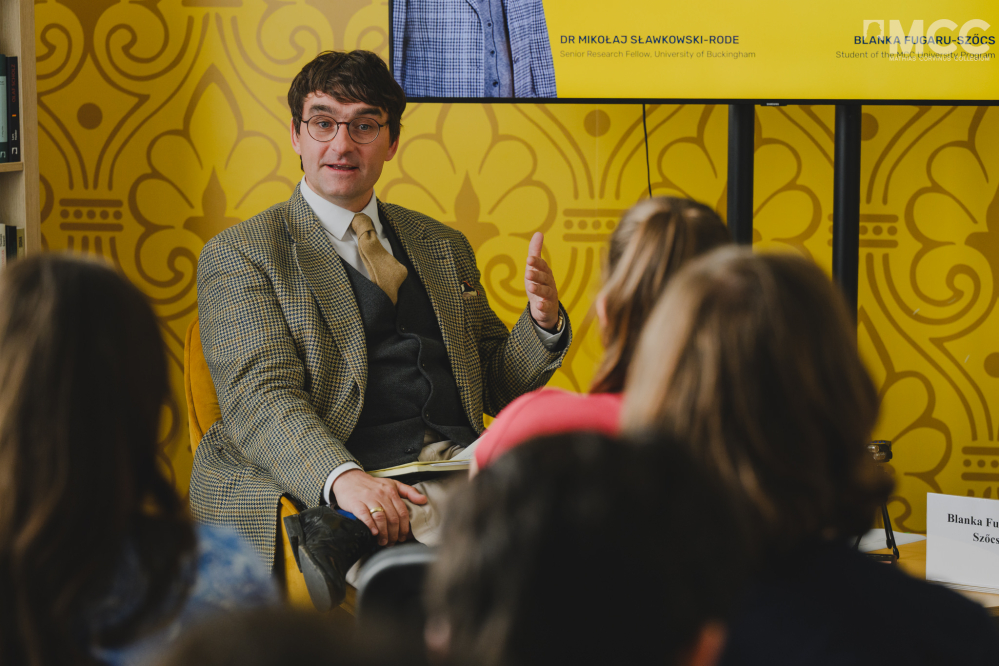
At this event of the MCC Transylvania Lectures series, Dr Mikołaj Sławkowski-Rode, Senior Research Fellow at the Humanities Institute of the University of Buckingham and Associate Professor at the Faculty of Philosophy of the University of Warsaw, examined the historical circumstances that elevated English to the status of a global language. Approaching the topic from philosophical, linguistic, and cultural-historical perspectives, he also questioned whether the factors behind the rise of English can remain sustainable in the long term. The moderator of the event was Blanka Fugaru-Szőcs, a student at the Faculty of Economics and Business Administration of Babeș–Bolyai University and in the MCC University Program.
According to Mikołaj Sławkowski-Rode, the obvious question is: why did English become the most important language in the world? The answer, he argued, lies in both historical and cultural-institutional contexts. For the British Empire, famously described as the empire on which “the sun never set,” English became one of its most significant exports, connecting different parts of the world in an unprecedented way. This process unfolded over centuries and reached its peak with the Industrial Revolution. After the Second World War, the growing geopolitical influence of the United States became another crucial factor in the spread of English.
This raises another question: why did English retain its dominant role even after the fall of the British Empire and, more recently, after Brexit? One reason is that by then English had already become deeply rooted in most former colonies, making a shift to another language, such as French, a long and costly process. Over time, English also lost some of its negative connotations: in many former colonies, it increasingly came to be seen as a neutral tool of communication.
Spain and France also made long-standing efforts to promote their own languages as international languages, yet English ultimately proved to be the one that met the widest range of criteria. It is relatively easy to learn and flexible enough to allow non-native speakers to communicate quickly. In this sense, it is also more “forgiving” of grammatical mistakes, strong accents, and imperfect pronunciation than many other languages. Its widespread use, moreover, makes it valuable and attractive, which is why so many people want to learn it. The speaker pointed out that being able to publish in English gives him a major advantage in academia: if he published the same work in his native Polish, his writings would reach a far smaller audience.
Even in a country such as China, there are many fields in which knowledge of English is indispensable. At airports, for instance, English is used around the world as a common language, since there is a need for a shared means of communication that many people can understand and use. Digital technology, programming, and pop culture also operate largely in an English-language environment. Much of the development of artificial intelligence and language models is likewise linked to Silicon Valley and the broader English-speaking technological sphere. If the world were to abandon English as a common language, it would require an enormous retraining effort and could slow progress in many areas.
There are languages that are imposed on people by a country’s leadership or by those in power, because without knowing them it becomes almost impossible to get ahead. This is a top-down process. Latin, for example, held an indispensable role for a long time thanks to the Roman Empire. Other languages, by contrast, spread because they are accessible, practical, and useful, so people choose to learn them of their own accord. This is a bottom-up process. “English ticks both boxes,” explained Mikołaj Sławkowski-Rode.
At the same time, however, a new trend is beginning to emerge — one that could reduce the exclusive importance of English. AI-based language models and instant translation technologies are already playing a significant role in this shift. The population of English-speaking countries, taken together, represents only a fraction of all English speakers worldwide, which is why these technologies may play an increasingly important role in connecting nations and people.
Blanka Fugaru-Szőcs also asked whether a more balanced distribution of global-language status could encourage richer cultural expression and deeper connections between people. According to Mikołaj Sławkowski-Rode, the Anglicization of the world has made many things more homogeneous. “In the past, if we travelled across Europe by train and looked out the window, we could tell whether we were in Poland or Germany,” he said. Today, this is no longer necessarily the case, partly because of the export of Western, Anglo-Saxon technologies and cultural patterns. A fairer linguistic balance could help counter this homogenization, but it would also raise another question: what is the value of diversity if we have no real awareness of one another?
There is no need to fear that English will suppress all other national languages. In recent years, both László Krasznahorkai and the Polish writer Olga Tokarczuk have been awarded the Nobel Prize in Literature. It is likely, however, that the judges read their works not in the original, but in English translation. This also illustrates the community-building power a global language can have. Without English, art, industry, technology, and many other fields could easily retreat into much narrower, local spheres.