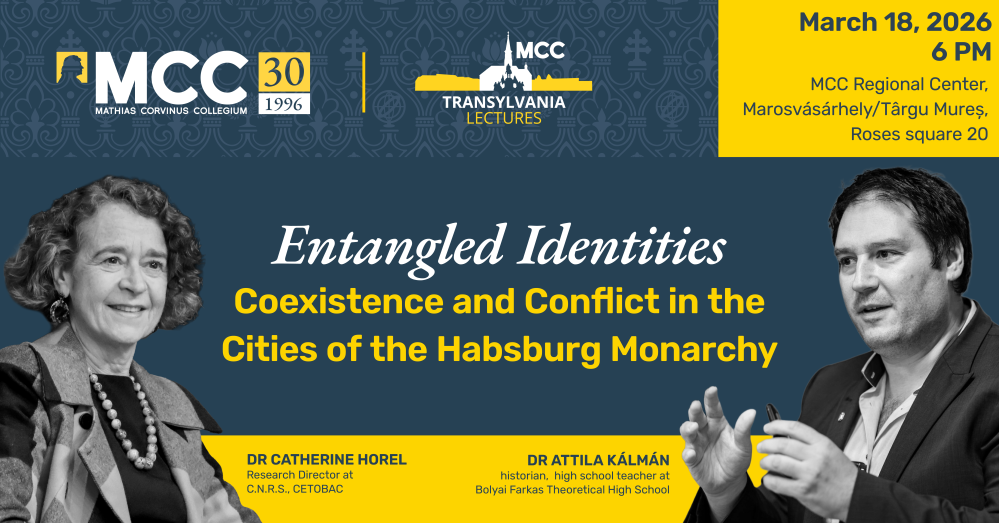
How did modernization reshape multilingual urban life in the decades before the First World War? Between 1880 and 1914, cities across the Habsburg Monarchy were not only spaces of coexistence, but dynamic arenas where modern identities were formed, negotiated, and contested.
Catherine Horel’s research offers a fresh perspective on the multicultural cities of the Monarchy at the turn of the nineteenth and twentieth centuries. Through a comparative study of twelve urban centers — including Arad, Nagyvárad/Oradea, Temesvár/Timișoara, Bratislava, Sarajevo, and Trieste — she examines the social and cultural diversity that defined the Empire’s final decades. Rather than focusing solely on imperial capitals, the project turns to the institutions of everyday urban life: schools, churches, associations, local politics, and the press.
In regions such as Transylvania, the Banat, and Bukovina, diversity was not an abstract ideal but a lived reality. Yet in the years following the Austro-Hungarian Compromise, urban space became increasingly politicized. Language and culture emerged as powerful instruments of self-assertion, while competing elites sought influence through education, religious institutions, civic organizations, and the public sphere.
Our event invites participants to reflect on how coexistence and conflict intertwined in the modern city — and what this history can teach us about identity, institutions, and public life in Central Europe today.
Our guest speaker will be Dr. Catherine Horel, Research Director at C.N.R.S., CETOBAC, Paris, president of International Committee for Historical Sciences (2021-2026). She deals with Contemporary History of Central Europe, her works focuses on Habsburg Empire and Hungary, their socio-political structures, urban, military history and Jewish history. Her major publications examine figures such as Miklós Horthy, the experience of defeat and the First World War, the history of the Hungarian nation, and the cultural encounters between France and Hungary in the nineteenth century.
At the event, she will be joined in conversation by Dr. Attila Kálmán, historian and high school teacher at the Bolyai Farkas Theoretical High School. In recent years, he has become widely known as a researcher and public advocate of Transylvanian aristocracy, historic noble families, and castle heritage. His lectures and publications frequently connect social history with cultural memory. Alongside examining aristocratic lifestyles, landed estates, and family histories, he pays particular attention to the major turning points of the twentieth century — including nationalization, deportations, and institutional disintegration — and to how these transformations reshaped the role of Transylvania’s historical elite within modern society.
We kindly ask you to inform us of your intention to attend by filling in the form below:
For more information follow our events on Facebook.
 March 18, 2026
 6:00 PM
 MCC Regional Center,