Private law is often described as the domain of autonomy, exchange, and interpersonal ordering, yet it can also serve as a remarkably effective medium of political domination.
This event examines how totalitarian regimes transformed civil-law institutions without necessarily abandoning the language of legality. Rather than focusing primarily on public-law repression, the discussion turns to the juridical techniques through which power penetrates property, contract, family relations, and succession. A central theme is the tension between normative continuity and functional rupture: what remains formally stable, and what changes in operation and effect.
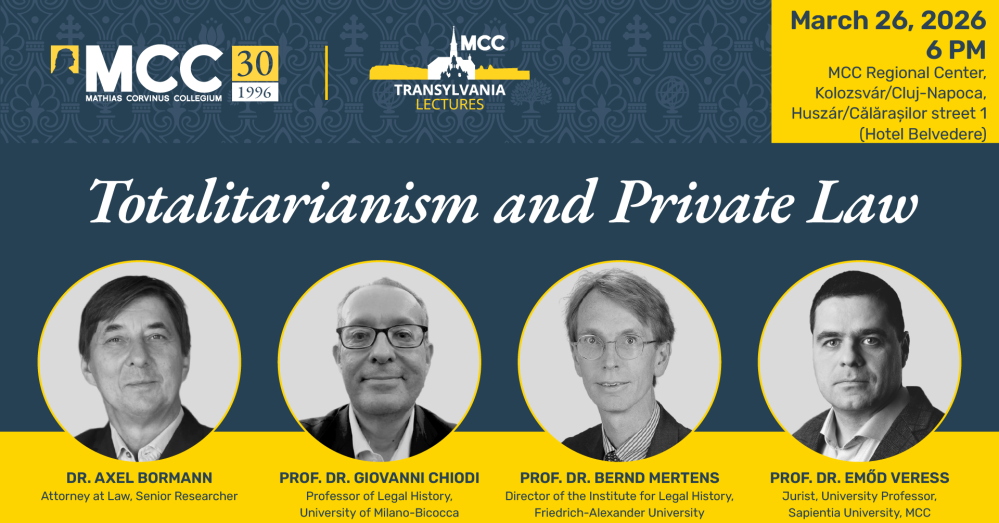
At this event, Prof. Dr. Bernd Mertens (Germany) analyses Nazi Germany, tracing how civil-law doctrine and adjudication were mobilized to produce exclusion, dispossession, and differential legal capacity. Prof. Dr. Giovanni Chiodi (Italy) addresses Fascist Italy, focusing on the corporatist reconfiguration of legal ordering and the integration of political objectives into ostensibly technical private-law instruments. Dr. Axel Bormann (Germany) turns to the German Democratic Republic, where private-law forms frequently persisted while administrative steering, surveillance, and structural dependency constrained the practical exercise of rights. Prof. Dr. Emőd Veress (Hungary/Romania) compares Soviet-style dictatorship in Hungary and Romania, exploring how socialist legality redefined ownership, obligation, and personhood under the claims of collective rationality.
Participants:
- Prof. Dr. Bernd Mertens, Director of the Institute for Legal History and holds the Chair of Civil Law, German and European Legal History at the Friedrich-Alexander University Erlangen-Nuremberg since 2004. In 2006, he was honoured with the Science Prize of the German Federal Parliament. In 2009, he published a fundamental monograph on law-making by the totalitarian Nazi regime. In 2019, his book „Gönner, Feuerbach, Savigny“ on the relationship between three outstanding 19th century jurists was chosen as one of the „Legal Books of the Year“.
- Prof. Dr. Giovanni Chiodi, Full Professor of Legal History, Department of Law, University of Milano-Bicocca. Co-director of LawArt Journal of Law, Art and History, and Italian Review of Legal History. He is the principal investigator of the NextGenerationEU-funded project (2022–2026), The Papers and the Code: Filippo Vassalli and Italian Legal History in the Mirror of his Archive.
- Dr. Axel Bormann studied law in Berlin, Edinburgh, and Bucharest. He later worked as a research assistant at the Institute for East European Studies in the Department of Law and Economics at the Free University of Berlin, where his research focused on the law of the former German Democratic Republic and Romania. He worked as a consultant on projects of the Council of Europe and the European Commission in Eastern Europe. He is also a practicing lawyer with an office in Berlin.
- Prof. Dr. Emőd Veress is a jurist and university professor. He is the Director of the Institute of Legal Studies at Sapientia University and a lecturer at Mathias Corvinus Collegium (MCC). He is also a professor at the Faculty of Law of the University of Miskolc. His research focuses on civil law and legal history.
We kindly ask you to inform us of your intention to attend by filling in the form below:
For more information follow our events on Facebook.
 March 26, 2026
 6:00 PM
 MCC Regional Center,